Blog Archive

Showing posts with label Watch. Show all posts

Citizen - Eco Drive Satellite Wave

I'm Watch


Smart watches are ugly. Except for this one!


The I'm Watch is a bit big, but it looks good.
(Credit: Rafe Needleman/CNET)


LAS VEGAS--I've seen a few companies lately try to recapture the newly free real estate of the wrist (now that people are using their phones as their watches) with teched-out watches, body monitors, and super, Android-powered gizmos.

They're cool, except they're not, because few of them are actually wearable in polite company. But the I'm Watch, from Italy, is not just a nicely powered smart watch, it looks like something you might actually want to wear. 

Yes, it's nearly as big as an iPod Nano, but at least it has curved glass. And you can get it in almost any material you like, from aluminum to gold to carbon.

The device is powered by Android (1.6) and comes with a music player, Twitter and Facebook clients, weather, and access to an app store for additional functions. It's Bluetooth-enabled so it will display the caller ID from your smartphone when somebody calls (I experienced this when using a WIMM-powered watch; it's a nice feature).


A touch screen gets you into apps. You can download more.
(Credit: Rafe Needleman/CNET)


It's got a nice touch-screen interface, and it's easy to move between apps. One big bonus: the apps look decent, not like science-fair projects.

The I'm Watch is the Armani of smart watches, though: basic models will start at $299, and if you want the gold or other fancy versions, expect to pay a lot more. The company is taking preorders now, and products should start shipping this quarter. There are dozens of color and material choices.
Until I saw this line of products I wasn't convinced that anyone could really capture this new market. But this product wins with strong design, both in the hardware and the software. It may cost more than an entire smartphone, but it looks like a nice tech luxury item.


by  


Read more: http://www.cnet.com/8301-33373_1-57356622/smart-watches-are-ugly-except-for-this-one/#ixzz1jENNhLFh

HD3 Slyde

Remember my earlier post on the HD3 Slyde?
http://les-revues.blogspot.com/2011/02/slyde-hd3-next-gen-digital-watch.html

One of the first few luxury watches to feature a touch screen concept.  It allows the user to switch the watch face and access a variety of features with just a swipe of the finger.  Cool!

It is now out and exclusively at http://www.ecollezione.com/  @ S$9,800

More information:
http://www.hd3complication.com/en/slyde-concept.php


Polar FT80

How would you like to carry an intelligent training computer on your wrist when you embark on your next workout or run?  This watch will definitely help you to achieve maximum efficiency and reach your workout targets for both cardio and strength training.

It features intuitive technology that includes the new Polar Star Training Program and Polar Fitness Test.  Training hard is important. Training smart is important too.

Check it out:  http://www.polar.fi/us-en/products/improve_fitness/fitness_crosstraining/FT80

World's most accurate clock unveiled


Posted on Feb 5th 2010 by Emma Woollacott

Physicists at the National Institute of Standards and Technology (NIST) have built the world's most accurate clock.
Noting that "aluminum is a better timekeeper than mercury" - thanks, we'll bear that in mind when making appointments - the team based the clock on a single atom of aluminum.
It's accurate to one second in about 3.7 billion years.
The new clock is the second version of NIST's quantum logic clock, so called because it borrows the logical processing used for atoms storing data in experimental quantum computing. The second version is more than twice as precise as the original.
"This paper is a milestone for atomic clocks" for a number of reasons, says NIST postdoctoral researcher James Chou, who developed most of the improvements.
It stomps all over the uselessly vague NIST-F1 cesium fountain clock - the US civilian time standard - which loses a whole second every 100 million years.
But because the international definition of the second is based on the cesium atom, cesium remains the 'ruler' for official timekeeping.
The logic clock is based on a single aluminum ion, trapped by electric fields and vibrating at ultraviolet light frequencies - 100,000 times higher than the microwave frequencies used in NIST-F1.
Optical clocks thus divide time into smaller units, and could someday lead to time standards more than 100 times as accurate as today's microwave standards.
Aluminum is just one contender for a future international time standard. NIST scientists are working on five different types of experimental optical clocks, each based on different atoms and offering its own advantages.
Optical clocks are already measuring possible changes in the fundamental 'constants' of nature - with important implications for the laws of physics.
Next-generation clocks might lead to new types of gravity sensors for exploring underground natural resources and fundamental studies of the Earth. Other possible applications may include ultra-precise autonomous navigation, such as landing planes by GPS. 

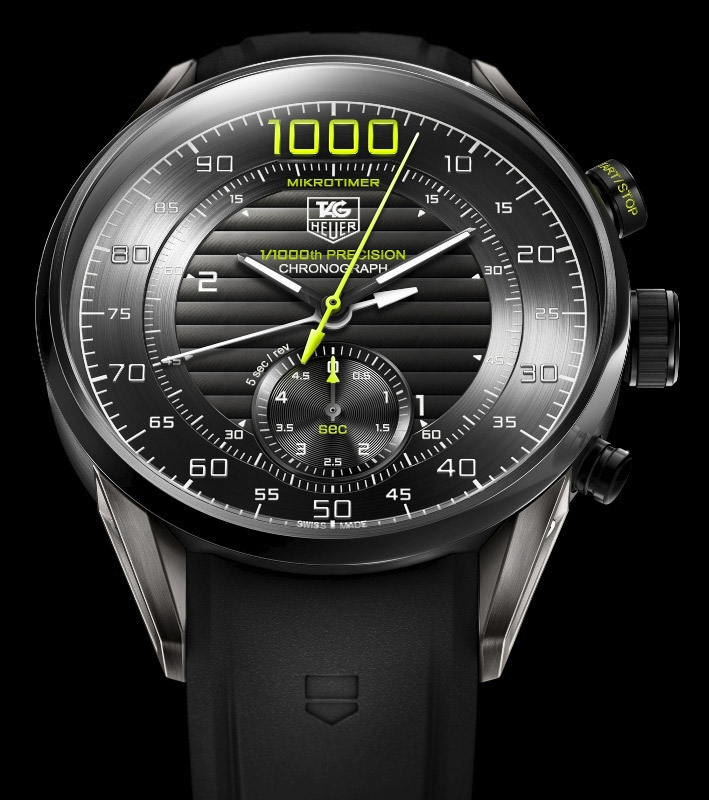
BASELWORLD 2011 - TAG HEUER - Mikrotimer Flying 1000 Concept Chronograph


What have we here? A 1/1000th of a second mechanical chronograph. 'nuf said. Awesome!


Movement
- Tag Heuer Mikrotimer Flying 1000 concept chronograph
- Manual chronograph (3,600,000 beats per hour))
- Automatic watch (28,800 beats per hour)

Dial
- “Black gold” coated “Côte de Genève” and black dial
- Chronograph minute and 1/12th of minute on central hand
- Chronograph 1/10th of a second at 6 o’clock calibrated to 5 seconds
- White superluminova arabic numerals
- 1000 yellow arabic numeral
- “Black gold” coated & polished hour and minute hands with luminescent markers
- Yellow central 1/1000th of a second chronograph hand
- Black & yellow chronograph hands
- Monochrome Tag Heuer logo
- Minuterie on the white flange

Strap
- Rubber strap

Case
- Case diameter: 45mm
- Titanium carbide coated case
- Double anti-reflective curved sapphire crystal
- Titanium carbide coated pushbuttons
- Titanium carbide coated & rubber crown
- Fine brushed titanium horns
- Sapphire case back to allow direct view of the decorated movement
- Water-resistance: 100 meters

Price? Sorry folks. Not yet. This is just a concept for now.

Check out the video.

More about the movement:
354 components

Movement Dimension
- Total diameter: 35.8 mm (15 ¾’’’)
- Total height: 7.95 mm

Frequency

- 28,800 vibrations per hour/ 4 hertz (watch)
- 3,600,000 vibrations per hour/ 500 hertz (chronograph)

Jewels
- 53 jewels

Power reserve
- 42 hours watch power reserve
- 150 seconds power reserve

Property of display
- Hours
- Minutes
- Central 1/1000th chronograph second
- Chronograph minute and 1/12th of minute on central hand
- Chronograph 1/10th of a second at 6 o’clock calibrated to 5 seconds

Mechanical features

- 1/1000th second chronograph function
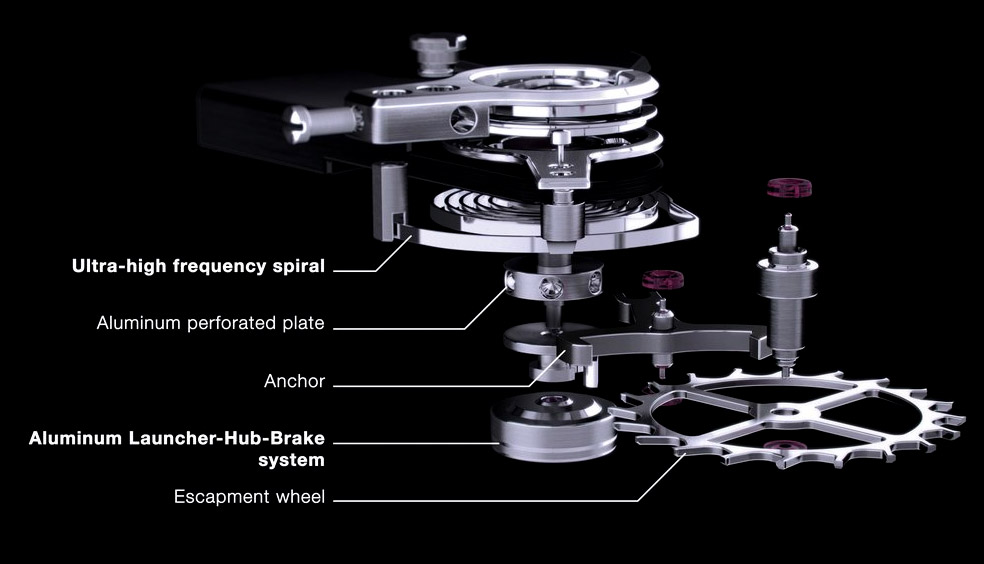
- High frequency mechanical regulating 500hz spiral for chronograph (patent pending)
(gives static stability and extremely high dynamism with limited dilation. Reduces gravity effects and shocks. Low amplitude increases the isochronous precision of the pulse)
- Traditionnal balance wheel for watch
- Automatic bi-directionnal rewinding movement
- Stop second (when setting the hour)

BASELWORLD 2011 - SEIKO - ANANTA AUTOMATIC CHRONOGRAPH DIVER'S WATCH


Limited to just 700 pieces and representing the Japanese art forms of Katana and hand-painted lacquer, this new Ananta is a winner!


High legibility is a vital attribute in a diving watch, and to ensure that the dive time is as readable as possible even in dark waters, SEIKO commissioned Isshu Tamura, a world-renowned lacquer artist, to create a dial that is truly jet black. Each dial is painted, layer by layer, and then polished by hand by Mr. Tamura in his studio in Kanazawa on the western shores of the Japanese mainland. Isshu Tamura was born in Kanazawa in 1957, and is a master of “Kaga Makie” which is a traditional style of lacquer. The legibility is further enhanced by the use of a non-reflective coating on the sapphire glass.

The design of Ananta is inspired by Katana, the ancient Japanese art of sword making. The katana sword was first developed more than 800 years ago and symbolizes the high value that Japanese culture puts upon traditional skills and innovative manufacture, and is therefore the perfect inspiration for Ananta.

“Limited Edition” and the serial numbers will be engraved on each case back. The watch is presented in an exclusive gift box with the “SEIKO 130th Anniversary” emblem.

Slyde HD3 - Next Gen Digital Watch

Slyde company has introduced a unique digital watch HD3, developed by designer Jörg Haysekom (Jorg Hysek). Watch is equipped with LED touch screen (OLED possible option) with moving vertically and horizontally different virtual screens. User can choose whatever background and layout he wants with a touch of a finger.

Watch case is made of titanium and sapphire glass - they are strong enough and can work under water, at a depth of up to 30 meters. There is also charge indicator on the side of the watch body. It features applications to view photos, its own calendar, but it has no media player. Maybe Slyde decided not to duplicate functions that everybody has on their cell phones or iPods.

Slyde HD3 will be available in autumn in black and silver colors and the price is not known yet.


What's the difference between an automatic and a quartz watch? Which is better?


Automatic/Manual Wind:
Quartz:
An automatic is a testament to the ability of watchmakers to put hundreds of little parts into a watch case and get them to work all together with close tolerances just to tell time. An automatic watch depends upon movement to power it while a quartz watch uses electricity for its power, typically a battery. It's a matter of opinion as to which is better... But all of those little parts mean that there are more things to break. Manual watches do not have a rotor to wind the mechanism, and rely upon the user to wind them.


An automatic/manual is usually more expensive to repair than quartz, but if you take care of the watch, you shouldn't have to worry about this. The nice thing about an automatic/manuals is that should water get into your watch, it won't kill it unless you don't have it serviced after the leakage occurs. An automatic/manual watch does not typically keep as accurate time as quartz would, and if you're an accuracy nut, this could get annoying. Another drawback is that you will likely have to reset your watch every now and then, which causes wear on the gaskets and increases the chance of water getting into your watch. Also keep in mind that every time you let the watch run out of power, you will have to reset the time.


An automatic can take some beating, but not as much as a quartz. Manual wind watches are usually somewhat tougher than automatics as they don't have the rotor spinning in the case. If you drop an automatic, there is a greater chance that something will be damaged. However, if you take care of an automatic/manual, it will last you a lifetime and you can pass it on to your family. Also, should you decide to sell your watch, an automatic/manual is more likely to fetch more money than quartz will. Also, an automatic's second hand sweeps nicely around the dial in a continuous motion. Some people think that an automatic has more of a "soul" than a quartz watch, as it depends on the motion of your arm to power it.

A quartz watch is a testament to humankind's technological know-how. A quartz watch requires less maintenance than an automatic. The only maintenance that the watch will typically need is a battery change and to have its gaskets changed annually if it's around water. It is very accurate, so this will stop you from having to unscrew the crown and cause wear on the gaskets. The down part to quartz is that if water gets into your watch, it usually means death to the movement. But the plus side to this is that it will be relatively inexpensive to replace a quartz movement than an automatic. The battery inside a quartz watch can leak acid and corrode the movement. This will usually happen if you let an expired battery to sit too long inside a watch after it dies. Thus it is a very good idea to have a quartz watch serviced immediately after its battery goes flat.


The great thing about a quartz watch is that it can sustain one heck of a beating and keep on ticking. So if you're rough on your watches, this is a major point that you should take into consideration when choosing which movement is best for you. Another great thing about a quartz watch is that you can take it off and let it sit on your desk for long periods of time and it will still be ticking when you decide to wear it again. Unless the battery dies, that is.


A quartz watch should last you all of your life if you take care of it,. Some people argue: why buy an expensive watch and take the risk of your battery no longer being available? This is a valid point, but if the past is any indication of the future, Omega will continue to support your watch for quite some time. The second hand on a quartz watch moves in one-second increments.

There is no "one better watch". One type of watch may better for you than the other. The best person to make that decision is you .

OMEGA Watches Co Axial Technology

Introducing Linq for iPod Nano

Linq for iPod nano 6G
iPod nano Linq Wristwatch
Introducing Linq
for iPod nano 6G
by Incipio

Incipio is taking a whole new design path with this wrist-worn carrying solution for the iPod nano. Meet the most rugged carrying solution for iPod nano produced to date, the Linq™. This is for users who already have or aspire for a lifestyle of action. Linq™ provides the user with an all-day, everyday accessory that may be worn effortlessly but always boldly.
The Linq™ design was born from the logical "link" between the idea of the iPod nano existing simultaneously as a timepiece and a media player. Linq™ is your ultimate watch, built to endure a rugged lifestyle. Your once fragile iPod nano is not so fragile anymore as it sits in Incipio's award winning Next Generation Polymer material securing to the wrist with a nylon and Velcro interchangeable strap.
iPod nano Linq - Blue
iPod nano Linq - Pink This durable and rugged iPod nano carrying option is a perfect solution for users who want to keep all functions of the nano close at hand (literally) at all times. Now you can wear your 6th generation iPod nano all day, everyday without a hint of it ever being worn (or torn).
The Linq™ is expected to release late-October for $24.99. Additional watchbands may be purchased for $9.99 each.

Kisai Broke is first USB rechargeable Watch from Tokyo Flash

Japanese watch vendor Tokyo Flash unleashed a new unique time piece with the Kisai Broke. The Kisai Broke is the first watch design from Tokyoflash to be USB rechargeable, meaning enhanced brightness and long lasting battery life.


Reading the time couldn't be easier. Touch the button and a shattering animation will light up the display. The outer ring of blocks represent hours in the same position as hours on a clock face. The inner ring of blocks represents five minute intervals in the same position as minutes on a clock face. Four single minutes are shown in the center.
  • Displays the time
  • USB rechargeable
  • LED animation option
  • Clasp: simple fold over clasp with push button
  • Minimum wrist size: 130 mm (approx.)
  • Maximum wrist size: 200 mm (approx.)
  • Case dimensions: 33 mm x 48 mm x 9 mm
  • Weight: 164 grams
  • Water resistance: 3ATM
  • Battery: LIR2032 rechargeable and replaceable standard watch battery
  • Japanese and English instructions
  • One year warranty
Kisai Broke is available for 15,900 Japanese yen ($168, €124, £110) including delivery. More details on Tokyo Flash.

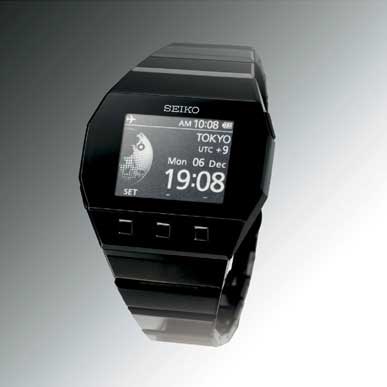
Seiko EPD concept watch

The Seiko EPD is a design concept watch, a prototype, but something very much like it will go on sale in the 2010 Northern Hemisphere autumn. A forebear of this watch was a prizewinner at the 2006 Grand Prix d’Horlogerie de Genève, kind of a big deal in the watchmaking world.

The big deal about this watch is the screen technology. It uses an Electrophoretic Display, hence the EPD in the name of the watch. EPD uses electronic ink technology – the very same type of technology so lauded for its readability in Amazon Kindle. Easy on the eyes, and eminently readable, even in the sunlight. It had a very wide viewing angle, almost 180-degrees, and displays 80,000 pixels, each of which can display one of four grey scale shades.

Like the Kindle, the Seiko EPD concept watch has a very low power consumption. But Seiko have gone a few steps better with power-saving. The screen of the Seiko EPD uses just 1/100th of the power that would be needed to run an e-book reader using the same sized screen.  This is really cool.  Welcome to the Future...

Popular Posts