Blog Archive

Showing posts with label Seiko. Show all posts

BASELWORLD 2011 - SEIKO - ANANTA AUTOMATIC CHRONOGRAPH DIVER'S WATCH


Limited to just 700 pieces and representing the Japanese art forms of Katana and hand-painted lacquer, this new Ananta is a winner!


High legibility is a vital attribute in a diving watch, and to ensure that the dive time is as readable as possible even in dark waters, SEIKO commissioned Isshu Tamura, a world-renowned lacquer artist, to create a dial that is truly jet black. Each dial is painted, layer by layer, and then polished by hand by Mr. Tamura in his studio in Kanazawa on the western shores of the Japanese mainland. Isshu Tamura was born in Kanazawa in 1957, and is a master of “Kaga Makie” which is a traditional style of lacquer. The legibility is further enhanced by the use of a non-reflective coating on the sapphire glass.

The design of Ananta is inspired by Katana, the ancient Japanese art of sword making. The katana sword was first developed more than 800 years ago and symbolizes the high value that Japanese culture puts upon traditional skills and innovative manufacture, and is therefore the perfect inspiration for Ananta.

“Limited Edition” and the serial numbers will be engraved on each case back. The watch is presented in an exclusive gift box with the “SEIKO 130th Anniversary” emblem.

What's the difference between an automatic and a quartz watch? Which is better?


Automatic/Manual Wind:
Quartz:
An automatic is a testament to the ability of watchmakers to put hundreds of little parts into a watch case and get them to work all together with close tolerances just to tell time. An automatic watch depends upon movement to power it while a quartz watch uses electricity for its power, typically a battery. It's a matter of opinion as to which is better... But all of those little parts mean that there are more things to break. Manual watches do not have a rotor to wind the mechanism, and rely upon the user to wind them.


An automatic/manual is usually more expensive to repair than quartz, but if you take care of the watch, you shouldn't have to worry about this. The nice thing about an automatic/manuals is that should water get into your watch, it won't kill it unless you don't have it serviced after the leakage occurs. An automatic/manual watch does not typically keep as accurate time as quartz would, and if you're an accuracy nut, this could get annoying. Another drawback is that you will likely have to reset your watch every now and then, which causes wear on the gaskets and increases the chance of water getting into your watch. Also keep in mind that every time you let the watch run out of power, you will have to reset the time.


An automatic can take some beating, but not as much as a quartz. Manual wind watches are usually somewhat tougher than automatics as they don't have the rotor spinning in the case. If you drop an automatic, there is a greater chance that something will be damaged. However, if you take care of an automatic/manual, it will last you a lifetime and you can pass it on to your family. Also, should you decide to sell your watch, an automatic/manual is more likely to fetch more money than quartz will. Also, an automatic's second hand sweeps nicely around the dial in a continuous motion. Some people think that an automatic has more of a "soul" than a quartz watch, as it depends on the motion of your arm to power it.

A quartz watch is a testament to humankind's technological know-how. A quartz watch requires less maintenance than an automatic. The only maintenance that the watch will typically need is a battery change and to have its gaskets changed annually if it's around water. It is very accurate, so this will stop you from having to unscrew the crown and cause wear on the gaskets. The down part to quartz is that if water gets into your watch, it usually means death to the movement. But the plus side to this is that it will be relatively inexpensive to replace a quartz movement than an automatic. The battery inside a quartz watch can leak acid and corrode the movement. This will usually happen if you let an expired battery to sit too long inside a watch after it dies. Thus it is a very good idea to have a quartz watch serviced immediately after its battery goes flat.


The great thing about a quartz watch is that it can sustain one heck of a beating and keep on ticking. So if you're rough on your watches, this is a major point that you should take into consideration when choosing which movement is best for you. Another great thing about a quartz watch is that you can take it off and let it sit on your desk for long periods of time and it will still be ticking when you decide to wear it again. Unless the battery dies, that is.


A quartz watch should last you all of your life if you take care of it,. Some people argue: why buy an expensive watch and take the risk of your battery no longer being available? This is a valid point, but if the past is any indication of the future, Omega will continue to support your watch for quite some time. The second hand on a quartz watch moves in one-second increments.

There is no "one better watch". One type of watch may better for you than the other. The best person to make that decision is you .

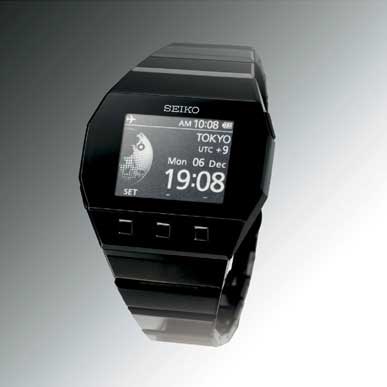
Seiko EPD concept watch

The Seiko EPD is a design concept watch, a prototype, but something very much like it will go on sale in the 2010 Northern Hemisphere autumn. A forebear of this watch was a prizewinner at the 2006 Grand Prix d’Horlogerie de Genève, kind of a big deal in the watchmaking world.

The big deal about this watch is the screen technology. It uses an Electrophoretic Display, hence the EPD in the name of the watch. EPD uses electronic ink technology – the very same type of technology so lauded for its readability in Amazon Kindle. Easy on the eyes, and eminently readable, even in the sunlight. It had a very wide viewing angle, almost 180-degrees, and displays 80,000 pixels, each of which can display one of four grey scale shades.

Like the Kindle, the Seiko EPD concept watch has a very low power consumption. But Seiko have gone a few steps better with power-saving. The screen of the Seiko EPD uses just 1/100th of the power that would be needed to run an e-book reader using the same sized screen.  This is really cool.  Welcome to the Future...

Popular Posts